
What does a shop or warehouse need for septic, water and electric in the San Antonio area?
Away from a city sewer main, a shop or warehouse needs a county on-site sewage facility permit before the system goes in, a service application to whatever utility serves the address for power, and either a water hookup or a registered well. Septic sets the pace.
Each county here runs its own on-site sewage program through a county authorized agent, most want a licensed professional to design the system, and the office has 30 days to rule once the planning materials are in. Power is a separate track with its own up-front money and its own posted waits, and no utility here posts a start-to-finish date.
Lot picked out? Each request goes to one independent contractor, whose call it is which jobs to accept.
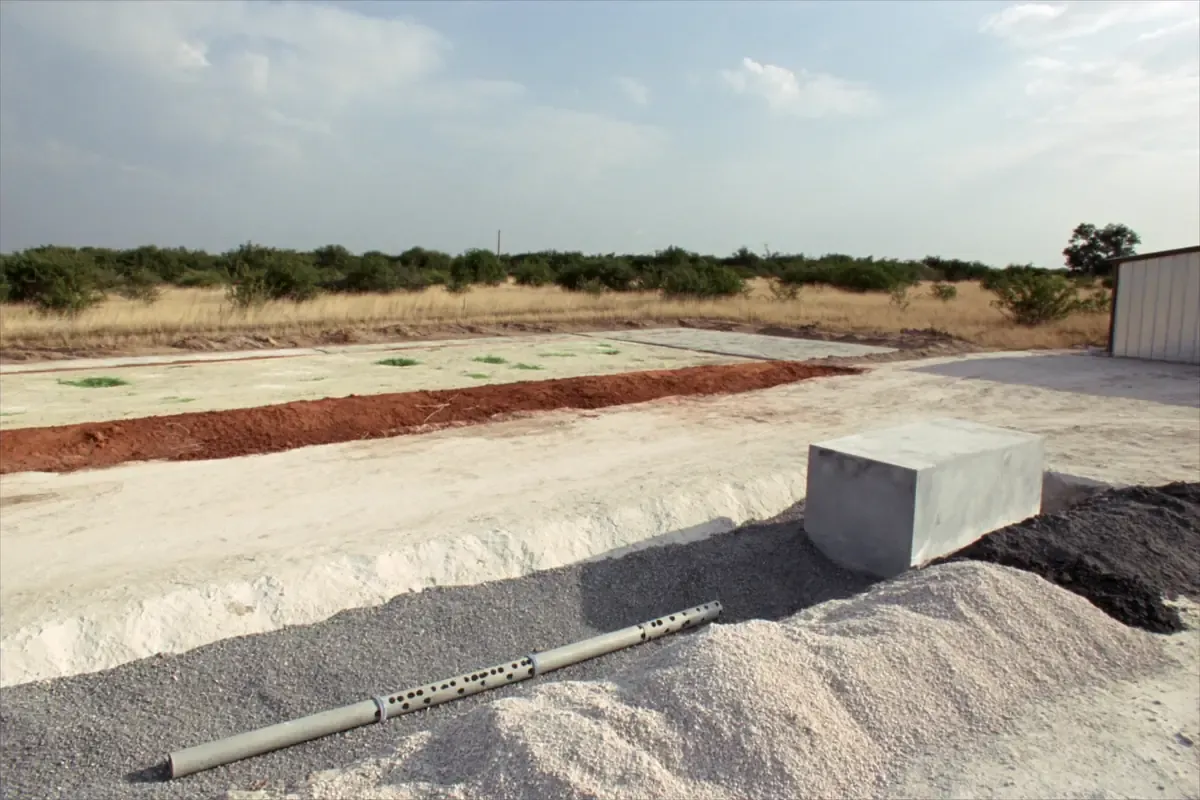
Three approvals the building permit leaves out
Septic, power and water all sit outside the building permit. Building, installing, altering or repairing a septic system (an on-site sewage facility, in the state's words) requires a permit and approved planning materials, and the permitting office has 30 days to rule on them. TCEQ says it is usually not that office, and that local programs can be stricter than the state minimums.
Around here the local program is always a county office. All seven have their own authorized agent on the TCEQ record, and coverage is uneven: the Bexar agent covers the county except four incorporated places the record names, without saying who permits inside those four; the Guadalupe agent covers the county except Marion; and the Wilson and Karnes agents cover only the unincorporated county. Big acreage is no escape hatch: TCEQ's 10 acre exemption covers a system for one single family dwelling, and only when it is the sole dwelling on the tract.
Checked at Texas Commission on Environmental Quality, getting a permit for an on-site sewage facility, 2026-09-13.
Checked at Texas Commission on Environmental Quality publication RG-472, on-site sewage facility rules compilation, 2026-09-13.
Checked at Texas Commission on Environmental Quality, On-Site Activity Reporting System, authorized agent search by county, records read for Bexar, Medina, Wilson, Atascosa, Guadalupe, Karnes and Frio, 2026-09-13.
The septic office in each county
Each of the seven names its own office. Checked at each county site, 2026-09-13:
| County | What the county site says | Office and number |
|---|---|---|
| Bexar | Every facility needs a permit, in four cases: new, repair, renewal, or a system found without one. | Bexar County Environmental Services, 210-335-6700 |
| Medina | All systems need a permit, and licensed people must design and install them. | Medina County Environmental Health, 830-741-6195 (also the floodplain office) |
| Wilson | The unincorporated area gets three permits from the county: development, septic and driveway. | Wilson County Permitting and Development, Floresville, 830-393-8357 |
| Atascosa | Inspections run Monday, Wednesday and Friday, booked a day ahead. | Atascosa County Environmental Health, Jourdanton, 830-769-2748 |
| Guadalupe | A permit is needed whatever the acreage, and a License to Operate has to be held before the facility is built or run. | Guadalupe County Environmental Health, Seguin, 830-303-8858 |
| Karnes | The application is a county form adapted from TCEQ form 0235, with a commercial and institutional section apart from single-family homes. | Karnes County designated representative, 830-780-3511 |
| Frio | Every system needs an engineer or registered sanitarian design plus an engineer flood study, because FEMA maps are not available for the unincorporated county. | Frio County designated representative, Pearsall, 830-505-7402 |
Checked at Texas Commission on Environmental Quality, On-Site Activity Reporting System, authorized agent search by county, records read for Bexar, Medina, Wilson, Atascosa, Guadalupe, Karnes and Frio, 2026-09-13.
Who may design a septic system for a non-residential building?
State rule 30 TAC 285.5 settles it, and the word commercial is not the trigger. A professional engineer or professional sanitarian has to seal the planning materials for non-standard treatment or disposal, manufactured housing communities, recreational vehicle parks, rented or leased multi-unit residential developments, subdivision and development plans, several systems on one large tract, and all new construction on the Edwards Aquifer recharge zone. An owner or installer may prepare them only where none of that applies.
The rules do call any building that is not a single-family home or a duplex a commercial or institutional facility, which puts a shop on the commercial side of a county form. Atascosa, Karnes, Frio and Medina each require a licensed designer by their own rule. Checked at each county site, 2026-09-13.
One trigger has no exceptions: on the Edwards Aquifer recharge zone, the planning materials for all new construction need an engineer's or sanitarian's seal. The building also waits on a separate TCEQ approval there, on the Edwards Aquifer sheet for Bexar and Medina.
Checked at Texas Commission on Environmental Quality publication RG-472, on-site sewage facility rules compilation, 2026-09-13.
Checked at Texas Commission on Environmental Quality, Edwards Aquifer Protection Program, 2026-09-13.
Septic permit fees, county by county
Five of the seven post a fee. Checked at each county fee document, 2026-09-13:
| County | Posted fees |
|---|---|
| Bexar | Public Works Permit Verification Guidelines list the cost as contact to verify, with a 30 day review; renewal is $30.00 every five years |
| Medina | Conventional $200.00; aerobic $400.00; reinspection $50.00 |
| Wilson | $250.00 for a single family residence needing no design and not platted; $350.00 where a design is required or the lot is platted; $400.00 for all others (the commercial line) |
| Atascosa | Commercial conventional $350, commercial aerobic $600; residential $250 and $400 |
| Guadalupe | Residential conventional $400; residential advanced treatment $500; multi-unit, rental community, condominium or commercial $600 |
| Karnes | No septic, development or driveway fee on any county page checked; the only posted fees are subdivision and plat fees in the 2013 regulations |
| Frio | Residential $200.00; commercial $450.00; aerobic $450.00, on the Road and Bridge schedule as of August 11, 2026 |
Which electric utility serves your lot?
The address decides, and no one utility covers all seven counties. Only one posts a county list: Karnes Electric Cooperative serves 12 South Texas and Coastal Bend counties between San Antonio and Corpus Christi, among them Atascosa, Bexar, Frio, Karnes, Medina and Wilson, and Guadalupe is not on it. The rest describe their process without posting a territory.
Checked at Karnes Electric Cooperative, apply for service, 2026-09-13.
Building a new commercial electric service
It is a long process with a design phase in the middle. CPS Energy treats new commercial electric and gas service as a 14 step process that opens with a commercial building application on its construction and renovation portal. Under 300 KVA is small commercial, usually overhead transformers; 300 KVA and up is large commercial, on a pad-mounted transformer. With the documents in hand it assigns a coordinator and starts design, and tells the customer to apply for permits at that stage because permits can take a long time.
The waits it posts cover pieces, not the whole: about 15 business days for underground crews to set and make up the transformer, up to three weeks to process easements, and 10 business days to set the meter and energize after the city inspection release.
Checked at CPS Energy, new commercial construction, 2026-09-13.
Co-op charges up front, and what a hookup costs
Money before design, and no posted total anywhere. Guadalupe Valley Electric asks for three to five weeks from request to connection and charges developers and builders a $6,000 engineering deposit up front, credited toward the final invoice. Medina Electric runs its own commercial application, counts industrial warehouses and office buildings as commercial, takes a non-refundable $100 engineering fee before the site visit, has the member clear 40 feet of right of way, and usually needs four to six weeks once a job goes to construction.
CPS Energy calls its charge the customer construction cost, or contribution in aid of construction: a one-time charge figured per project from materials, labor and time. No dollar amount, deposit or engineering fee for a new commercial hookup shows on any CPS Energy page checked, and the line extension policy with the figures is not online. On an industrial building or warehouse, settle the easement and the right of way clearing before the pad gets shaped.
Checked at Guadalupe Valley Electric Cooperative, developer and builder resources, 2026-09-13.
Checked at Medina Electric Cooperative, start or stop service, 2026-09-13.
Checked at Karnes Electric Cooperative, apply for service, 2026-09-13.
Checked at CPS Energy, customer construction cost, contribution in aid of construction, 2026-09-13.
Water: a hookup or a well?
It comes down to whether a main reaches the lot. San Antonio Water System calls installing new water or wastewater connections to its mains a new service, a vacant lot included. Tying a private service lateral outside the city limits and inside the Edwards recharge zone into the city sanitary sewer takes its own permit, pulled by a licensed master plumber, with a $40 fee.
The bigger number is the impact fee, charged once on new development in its service area per equivalent dwelling unit, on a schedule in force from July 1, 2024:
| Meter | Equivalent dwelling units | Low elevation | Middle elevation | High elevation |
|---|---|---|---|---|
| One inch | Two | $10,940.00 | $11,408.00 | $11,974.00 |
| Two inch | 14 | $76,580.00 | $79,856.00 | $83,818.00 |
Checked at San Antonio Water System, developer resources, new service, 2026-09-13.
Checked at San Antonio Water System, water and sewer impact fees by meter size, July 2024, 2026-09-13.
Sewer impact fees
SAWS prices sewer impact per equivalent dwelling unit by area, not by meter size: from $1,873.00 a unit in Lower Medina up to $5,541.00 a unit in Upper Collection.
Checked at San Antonio Water System, water and sewer impact fees by meter size, July 2024, 2026-09-13.
Drilling a well over the Edwards Aquifer
That takes a permit, from a different agency than the one reviewing the aquifer plan. The Edwards Aquifer Authority covers more than 8,000 square miles over eight counties: all of Uvalde, Medina and Bexar, and parts of Atascosa, Caldwell, Guadalupe, Comal and Hays. Drilling into or through the aquifer starts with a well construction permit application, and the fee is $25. Capping or plugging an old well takes an Authority permit as well, $125 for capping and $25 a well for plugging.
Registration is its own step. To count as exempt, and pump without a groundwater withdrawal permit, the owner registers the well and shows it cannot yield more than 25,000 gallons a day, serves domestic or livestock use only, and does not supply a subdivision that needs platting. A well serving a business is worth running against that test. Outside the Authority area a local district handles groundwater: the county permit list sends a Medina County property without public or community water to the Medina County Ground Water Conservation District, 830-741-3162 (checked 2026-09-13).
Checked at Edwards Aquifer Authority, learn about the aquifer, 2026-09-13.
Checked at Edwards Aquifer Authority, well closure procedures and construction, 2026-09-13.
Checked at Edwards Aquifer Authority, well registration and updates, 2026-09-13.
A warehouse with a restroom and a break room
Off a sewer main, it needs a permitted on-site sewage facility on the commercial side of the county form. The rules count any building that is not a single-family home or a duplex as a commercial or institutional facility, so a warehouse with plumbing is not just a house with a bigger tank. Guadalupe, Atascosa and Frio each price a commercial system on its own line.
What size the system has to be is not on any page checked for this site. No document on record here sets a fixture count, a gallons per day figure or a tank size, so none shows on this site; those come out of the planning materials the designer draws up. A building with no plumbing fixtures has no system to permit, which is why an open equipment shed and a finished-out shop are two different jobs on paper.
Checked at Texas Commission on Environmental Quality publication RG-472, on-site sewage facility rules compilation, 2026-09-13.
Checked at Texas Commission on Environmental Quality, getting a permit for an on-site sewage facility, 2026-09-13.
What waits on what
Get the applications in first, since they run on clocks no one on the job can speed up: 30 days for the county to rule on septic, plus weeks of transformer work and easement processing. Run them alongside the building design, not after. A septic field, a water line and an electric trench all want ground the pad and drive also want, and moving a trench once the concrete is down is the costly way to do the same job. The whole order of work: the start-to-finish San Antonio guide.
Checked at Texas Commission on Environmental Quality, getting a permit for an on-site sewage facility, 2026-09-13.
Checked at CPS Energy, new commercial construction, 2026-09-13.
The trades behind the utilities
Several licensed trades, and one Texas does not license. A professional engineer or professional sanitarian designs the septic system, or, where no state trigger applies and the county allows it, the owner or installer. A licensed master plumber pulls the San Antonio Water System lateral permit on the recharge zone, and an electrician does the install the utility inspects before the meter is energized.
The building itself is the unlicensed part, so every credential here belongs to someone else: the engineer or sanitarian sealing the septic design, the master plumber on the recharge-zone lateral permit, the electrician the utility inspects. One independent metal building contractor coordinates those trades and prices the work.
Ask anyone bidding a metal shop building which items are in the contract and which stay with you: the septic permit and design, the utility applications and deposits, the easements, the trenching. Get that split in the written estimate. What Bexar County, TX and the six counties around it add on top is a separate list.
Checked at Texas Commission on Environmental Quality publication RG-472, on-site sewage facility rules compilation, 2026-09-13.
Checked at Sunset Advisory Commission, Texas Residential Construction Commission; TDLR regulated industries list, 2026-09-13.
What owners ask
Septic, water and power for a shop or warehouse around San Antonio: what is needed?
Away from a city sewer main: a county on-site sewage facility permit, a power service application to whatever utility serves the address, and either a water hookup or a registered well. The septic system needs a permit and approved planning materials before it is built, and the permitting office has 30 days from receipt to rule on them. All seven counties here have their own authorized agent on the TCEQ record, so a county office, not TCEQ, permits the septic system. No utility checked here posts a start-to-finish time for a new commercial hookup. Checked at the TCEQ, county and utility sites, 2026-09-13.
Which office issues a commercial septic permit in Bexar County, TX?
Bexar County Environmental Services, under Public Works, 210-335-6700. The county requires an on-site sewage facility permit in four cases: new, repair, renewal, and an existing system found without one. Renewal on a standard system comes every five years: a pump receipt plus a $30.00 fee. The county Public Works Permit Verification Guidelines list the septic permit cost as contact to verify, with a 30 day review, and four incorporated places fall outside the county agent area on the TCEQ record, so confirm which agent covers the address. Checked at the Bexar County On-Site Sewage Facilities page and the Public Works Permits Verification Guidelines, 2026-09-13.
Must an engineer design a commercial septic system in Texas?
No single statewide rule says so, but the county usually gets there. State rule 30 TAC 285.5 requires a professional engineer or professional sanitarian to seal the planning materials for non-standard treatment or disposal, manufactured housing communities, recreational vehicle parks, rented or leased multi-unit residential developments, subdivision and development plans, several systems on one large tract, and all new construction on the Edwards Aquifer recharge zone, and an engineer where secondary treatment is required. The rule does not list a commercial building as a trigger by itself, but Atascosa, Karnes, Frio and Medina counties each require a licensed designer by their own rule. Checked at TCEQ publication RG-472 and the four county sites, 2026-09-13.
How long until a new commercial building has power?
No utility here posts a start-to-finish time, only waits on pieces of the job. CPS Energy posts about 15 business days for underground crews to set and make up the transformer, up to three weeks to process easements, and 10 business days to set the meter and energize after the city inspection release. Guadalupe Valley Electric asks for three to five weeks from request to connection, plus seven to 10 business days for a permanent meter. Medina Electric usually needs four to six weeks once a job goes to construction, and Karnes Electric energizes the meter up to three business days after a passed inspection. Checked at the CPS Energy, GVEC, Medina Electric and Karnes Electric service pages, 2026-09-13.