
Building a metal building in San Antonio, start to finish
A metal building in San Antonio goes up in one order: pin down the lot, engineer the slab to the building, get the permit from the office that has your address, clear the state items that apply everywhere, then stand the steel. Most of what follows hangs on one fact: is the lot inside a city, or out in the unincorporated county? Bexar, Medina, Wilson, Atascosa, Guadalupe, Karnes and Frio each answer that their own way, and every rule below shows where it was checked and when.
Lot picked out? Each request goes to one independent contractor, whose call it is which jobs to accept.
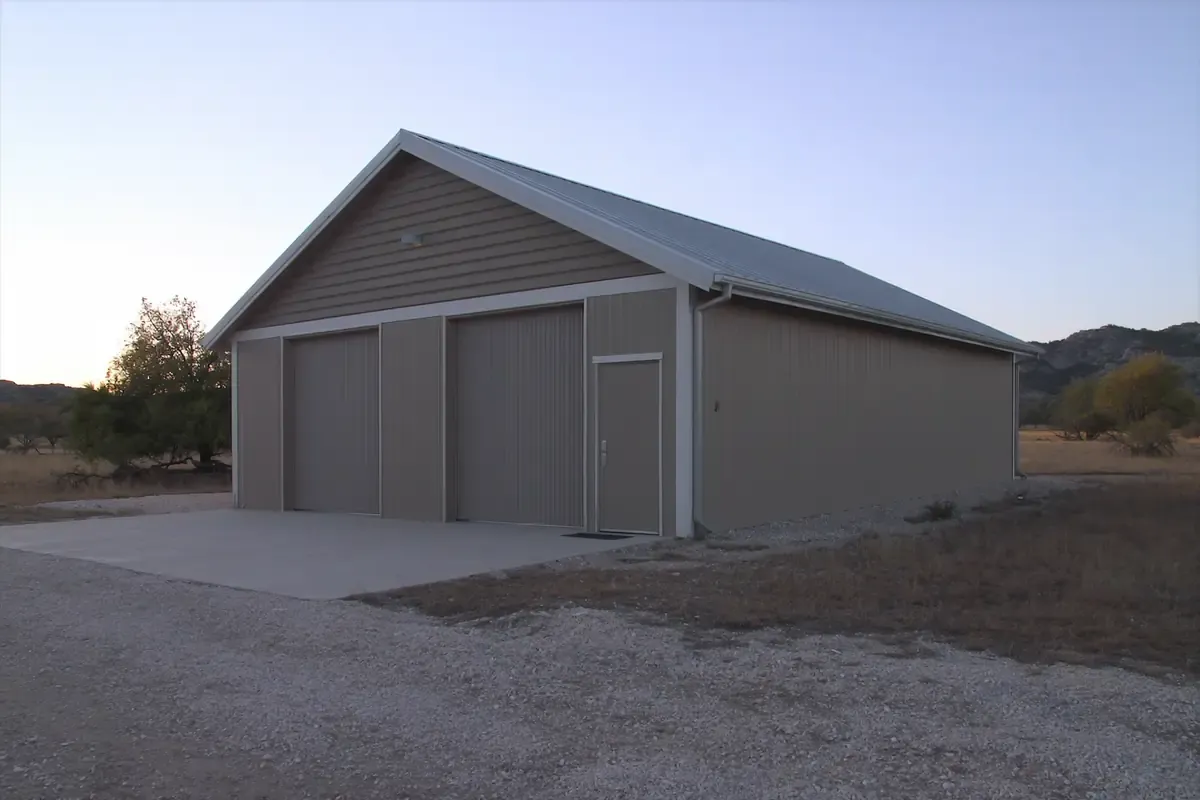
City lot or county lot?
Inside a city, the city owns the permit, the code and the inspections. Past the last city limit the county answers, and a Texas county answers with less than most owners expect. San Antonio, Castroville, Hondo, Floresville, Pleasanton, Jourdanton, Seguin, Schertz, Cibolo, Karnes City, Kenedy, Pearsall and Dilley all run their own permits, as do other incorporated towns in these counties, so no county answer covers an address inside one of them; call that city. Each county has a sheet on the county index, and all seven permit answers sit on one screen, floodplain, septic and driveway contacts included, on the San Antonio permit office list.
Between city and county sits the extraterritorial jurisdiction, the unincorporated ring around a city. Local Government Code 212.049 gives the city no power to require its building permits out there or to enforce its building code there. Section 212.046 is the lever a city keeps: on a covered tract, a building permit, or any other development permit, may not be issued by any city, county or other government official until the city has the development plat filed and approved.
Bexar County Public Works spells out what that means for a lot: inside the City of San Antonio extraterritorial jurisdiction, the Permit Verification Form and the site plan also take a stamp from City of San Antonio Storm Water Review staff, and tree, irrigation and signage permits come from whichever city holds that jurisdiction.
Four facts about the lot steer the rest of the job. Settle all four before anyone draws a building:
Who has the address: a city, the unincorporated county, or the unincorporated county inside a city extraterritorial jurisdiction.
Whether any part of the lot sits over a regulated Edwards Aquifer zone. In this region the TCEQ program pages list Bexar, Medina, Comal, Uvalde and Kinney counties, only parts of the aquifer are regulated, and TCEQ sends you to its own map viewer to settle a given site.
Whether any of it lies in the floodplain. In Bexar County, Public Works reviews every construction activity on property near the 100-year floodplain, may ask for a flood study by a professional engineer, and charges $50 per activity. The other counties each answer floodplain questions through their own office, and Karnes County posts no standalone floodplain permit page, so that one takes a call to the permits office at 830-780-3511.
How the drive meets the road. Frontage on a state highway and frontage on a county road are two separate permits, and neither is the building permit.
Checked at Texas Legislature Online, Local Government Code Chapter 212, municipal regulation of subdivisions and property development, 2026-09-13.
Checked at Bexar County, building permits, 2026-09-13.
Checked at Texas Commission on Environmental Quality, Edwards Aquifer Protection Program, 2026-09-13.
Checked at Bexar County, Floodplain Development Permits, 2026-09-13.
What makes a metal building pre-engineered?
The frame is engineered for one building on one site, then fabricated to that order and trucked out. Main frames are rigid steel, red iron in shop talk, set on anchor bolts cast into the slab. Purlins span the roof frames, girts span the walls, and the panels screw to both. Doors, windows, insulation and trim go on the order, because the plant punches and welds the frame for them before it ships. Moving a door after the steel is detailed is a bigger job than moving a stud wall.
Contracts come two ways. A package is the steel on a truck, and the slab, site work, erection and finish-out are yours to line up. Turnkey puts all of it in one scope. An owner who has already bought a package wants erecting a pre-engineered steel package: a slab, a crew and a crane, not a building order.
Texas law leans on the word pre-engineered. Occupations Code 1001.056 lets a building skip the state engineering chapter when nobody holds out to offer engineering services to the public and the building is one story, 5,000 square feet of floor or less, with no clear span wider than 24 feet across its narrow side. Where a building that size does have an unsupported span over 24 feet, the engineering requirement falls only on the roof framing, meaning its trusses, beams and other members holding up the roof, which has to be engineered or pre-engineered. Also exempt under that section: a private home, a garage or other structure pertinent to one, and a private building serving only farm, ranch or agricultural use.
The type of building moves the paperwork more than it moves the steel, since occupancy drives plan review, accessibility and parking. All nine types are on nine building types. The heaviest paperwork falls on commercial steel buildings and industrial buildings and warehouses; the lightest, usually, on metal shop buildings and post-frame and pole barn buildings.
The other four fall in between, and each turns on one question. RV and detached garages turn on two clear heights and the drive out to the road. Storage buildings for equipment and RVs turn on how many sides are closed in and what floor sits under each bay. Churches and community halls are assembly occupancy, a complex plan inside San Antonio at any size. Covered courts and pickleball halls turn on whether the space is conditioned, which is what brings the energy code in. An owner already holding the steel wants erection of a package instead of any of these.
Checked at Texas Legislature Online, Occupations Code Chapter 1001, engineers and engineering, 2026-09-13.
Why is the slab designed before the building?
Because the building sits on it bolt for bolt. Anchor bolts cast into the concrete hold the frame down at the spacing on the manufacturer's anchor bolt plan, and the column reactions on that plan size the foundation. Pour before that plan exists and the slab may have to be drilled, cut or poured over. Order of work: building drawings, then foundation design, then concrete. Details on the slab and foundation sheet.
The ground here changes fast. The USDA soil surveys of Bexar (1966), Medina (1977), Wilson (1977), Atascosa (1980) and Guadalupe (1977) counties, checked 2026-09-13, describe three different problems within an hour of each other. North Bexar and north Medina are shallow or very shallow stony soil over hard fractured limestone. The Bexar uplands east and west, and close to half of Guadalupe County, are deep shrink-swell clay, and the Guadalupe survey rates shrink-swell potential in the Houston Black-Heiden association very high. South and east, the Wilson and Atascosa surveys list shrinking and swelling, low soil strength and corrosivity to uncoated steel as the main limits of their biggest soil associations.
Rock close to the surface changes the digging, deep clay changes the slab section and the moisture details around it, and sand changes compaction and drainage. So two identical buildings 20 miles apart get two different foundations, and a geotechnical report pays for itself.
Put in writing who seals the drawings. The City of San Antonio commercial project application guide requires every structural sheet, meaning the foundation and the structural framing, to be designed and stamped by a Texas professional engineer, and says trade and civil documents may need engineering too, depending on scope. The architect question is separate: Occupations Code 1051.606 lets someone who does not present themselves as an architect draw the plans for a commercial building in private hands that stands no more than two stories and covers no more than 20,000 square feet, or for a warehouse the public has limited access to.
Checked at City of San Antonio Development Services, commercial project application guide, 2026-09-13.
Checked at Texas Legislature Online, Occupations Code Chapter 1051, architects, 2026-09-13.
Which office issues the permit?
The one with your address, and a city and a county do not work alike. A city reviews plans against a building code it has adopted. A Texas county cannot: Local Government Code Chapter 233, checked end to end, leaves a county without power to adopt a general commercial building code, or a structural, mechanical, plumbing or electrical code, for the unincorporated area. The only power in that chapter that reaches a commercial building is a fire code permit, and under section 233.061 only a county of more than 250,000 people, or one bordering a county that size, may adopt one. The side-by-side is in the permit sheet for San Antonio and Bexar County.
Inside the City of San Antonio a commercial job moves through Development Services in this order: zoning, plan intake, plan review, permit, inspections, utility release, certificate of occupancy. The completeness check usually takes up to three business days. A business or mercantile building of 7,999 square feet and under is a minor plan, with eight business days for the first technical review; at 8,000 square feet and up it is a complex plan at 18 calendar days, and assembly, education, factory, high hazard, institution, residential, storage and utility occupancies are complex at any size. The application and the permit both lapse after 180 days with no proof of progress.
In unincorporated Bexar County the Fire Marshal Office (210-335-0300) decides when a structure not for single-family dwelling use needs a building permit, and a single-family dwelling there means one structure holding three or fewer dwelling units. The permit reaches site clearing as well as building, renovating or changing occupancy. Public Works signs a Building Permit Authorization first, applications are taken in person by appointment only, and the county then has 30 days to issue or deny.
The other six counties answer for themselves. Atascosa County requires a building permit in the unincorporated area ahead of any new commercial or public building, a remodel for a new kind of business, or a multifamily dwelling with four units or more. Guadalupe County requires one before anyone builds or substantially improves a commercial establishment, public building or multi-family dwelling, under its fire code order effective February 1, 2026. Wilson County posts a development permit at $100 per application, and a commercial structure gets a fire safety meeting before approval.
Medina, Karnes and Frio post no building permit for a commercial or accessory structure. Medina County's permit list runs to 911 addressing, water well, floodplain, septic, and driveway and utility, with no building department and no code edition named. Karnes County lists special projects, septic, and road and bridge permits, with no building official and no fire marshal page. In Frio County the Road and Bridge Department handles septic, floodplain, utility right of way and pipeline permits. Check with the county either way: the state items below reach every address in all seven (each county's own site, checked 2026-09-13).
Whole chapter checked; it gives counties no such power. Checked at Texas Legislature Online, Local Government Code Chapter 233, county regulation of housing and other structures, 2026-09-13.
Checked at City of San Antonio Development Services, business and commercial projects, 2026-09-13.
Checked at City of San Antonio Development Services, commercial project application guide, 2026-09-13.
Checked at Bexar County, building permits and fire marshal code enforcement pages, 2026-09-13.
The $50,000 accessibility line
At a total estimated construction cost of $50,000 and up, the project must be registered with TDLR, the state licensing department. The full construction set then goes to a registered accessibility specialist, who reviews it under Administrative Rule 68.50. Below $50,000 there is no duty to register, the Texas Accessibility Standards still apply, and the owner may still register the job on the Special Project Registration form.
The figure that decides it is not the whole budget. TDLR says to leave out the cost of buying the site, fees for architects, engineers or consultants, furnishings, and equipment that sits outside the building mechanical systems. Land, design fees and furniture come out of the number. TDLR lists what comes out, not what goes in, so settle the figure with the design professional who files the plans.
The fees TDLR posts for itself, all non-refundable and all paid before the service:
| Item | Fee |
|---|---|
| Project filing | $175 |
| Late filing, when the project is registered after construction is done | $300 |
| Special review or inspection | $215 per hour, minimum one hour |
| Plan review and inspection by TDLR | Set by estimated construction cost; no dollar tiers posted |
| Registered accessibility specialist | Set by the specialist; TDLR posts no amount |
Checked at Texas Department of Licensing and Regulation, Architectural Barriers frequently asked questions, 2026-09-13.
Checked at Texas Department of Licensing and Regulation, Architectural Barriers special project registration application, 2026-09-13.
Checked at Texas Department of Licensing and Regulation, Architectural Barriers fee schedule, 2026-09-13.
Private homes, and one county that checks at the counter
TDLR says the accessibility law and standards are for public and commercial buildings and facilities, and do not reach private residences. A shop behind your own house is a different case from one you lease out, and the TDLR sheet works through the edge cases. One county holds the line at its own counter: where Government Code Chapter 469 applies, the Atascosa County Fire Marshal may turn away the permit application until the project is registered and the applicant hands over the registration number and Form AB042 (county permit and inspection process overview, checked 2026-09-13).
Checked at Texas Department of Licensing and Regulation, elimination of architectural barriers at a glance, 2026-09-13.
The Edwards Aquifer plan in Bexar and Medina
If your lot sits over a regulated zone, an approved Edwards Aquifer protection plan has to come before construction, and it is the longest wait on this page. TCEQ requires the approved plan in hand before work starts on the recharge, transition or contributing zone, and its program pages list Bexar, Medina, Comal, Uvalde and Kinney counties for this region. Only parts of the aquifer are regulated, so TCEQ's map viewer, not the county line, tells you whether your parcel is in. Start with the Edwards Aquifer sheet, and see Bexar County and Medina County for local context.
The zone picks the plan. On the recharge zone, nothing regulated happens without an approved water pollution abatement plan, and TCEQ's list covers putting up buildings, utility stations, roads, highways and railroads, plus clearing, digging, and anything else that changes the lay of the ground, its geology or how it takes in recharge. Clearing the pad is on that list. The contributing zone has its own plan, needed only when the work disturbs five acres or more, or the lot belongs to a wider plan for development or sale. A lot partly on the recharge zone that drains back onto it is handled as if all of it sat on the recharge zone.
Both the calendar and the fee are posted. TCEQ sets the administrative review two weeks after submission and gives it up to 30 days; payment runs through TCEQ EPay after that; then technical review has 90 calendar days, with two 14-day windows to answer deficiencies. No regulated activity may start before approval, so this goes at the head of the schedule. The application fee depends on the acreage of the whole property within its legal boundaries and on the kind of development, with a $650 floor and a $10,000 ceiling, and a non-residential job starts at $3,000 below one acre. Those are TCEQ's charges for its own review, not construction costs.
Checked at Texas Commission on Environmental Quality, Edwards Aquifer Protection Program, 2026-09-13.
Checked at Texas Commission on Environmental Quality, Edwards Aquifer Protection Program, what plans you might need, 2026-09-13.
Checked at Texas Commission on Environmental Quality, Edwards Aquifer application and review process, 2026-09-13.
Checked at Texas Commission on Environmental Quality, Edwards Aquifer application fee form TCEQ-0574, 2026-09-13.
When does construction stormwater coverage start?
At one disturbed acre. Work that disturbs an acre or more of soil and sends stormwater to surface water in the state needs coverage under the TCEQ construction general permit, with a stormwater pollution prevention plan in place before the job starts. The acreage is soil disturbed, pad, drive, laydown yard and utility trenches included, not the building footprint.
| Soil disturbed | What the permit asks |
|---|---|
| Five acres or more (large construction) | Notice of Intent through STEERS before work begins; Notice of Termination within 30 days of final stabilization. Notice of Intent fee: $225 filed electronically, $325 on paper. |
| One acre to under five (small construction) | No Notice of Intent. A signed small construction site notice posted at the site, with a copy to the storm sewer operator at least two days before work begins. |
| Under one acre, not part of a wider common plan of development or sale | Outside the permit. |
Checked at Texas Commission on Environmental Quality, construction stormwater general permit TXR150000, 2026-09-13.
Checked at Texas Commission on Environmental Quality, general permit TXR150000, fees, 2026-09-13.
Stormwater coverage over the aquifer
Coverage does not free up a lot over the aquifer: the general permit bars construction on an Edwards-regulated site until TCEQ approves the protection plan. And if the discharge point is within 10 stream miles upstream of the recharge zone, send the TCEQ San Antonio regional office its own copy of the Notice of Intent. Erosion control and the order of work on the ground are on the pad and site prep sheet.
Checked at Texas Commission on Environmental Quality, general permit TXR150000, part II, 2026-09-13.
Septic, water and power for the building
On a rural lot, a septic permit from the county and a service request to whichever utility serves the address, both started early. Building, installing, altering, extending or repairing a septic system (an on-site sewage facility, in the state's words) requires a permit and approved planning materials, and the permitting office has 30 days from receipt to rule on them. TCEQ says it is usually not that office, and that local programs can be stricter than the state minimums.
Here the office is always the county. All seven counties have their own authorized agent on the TCEQ record, every one in the TCEQ San Antonio region, so TCEQ itself permits septic nowhere in these seven. Coverage is uneven: the Bexar agent covers the county except four incorporated places the record names, without saying who permits inside those four; the Guadalupe agent covers the county except the City of Marion, while Seguin, New Braunfels and San Marcos run their own; and the Wilson and Karnes agents cover only the unincorporated county.
The septic rules do not treat a shop or warehouse like a house. State rule 30 TAC 285.5 counts any building that is not a single-family home or a duplex as a commercial or institutional facility, and it requires a professional engineer or professional sanitarian to prepare and seal the planning materials for non-standard treatment or disposal, for subdivision and development plans, for several systems on one large tract, and for all new construction on the Edwards Aquifer recharge zone. Where secondary treatment is required, it has to be a professional engineer.
Power runs on its own calendar. CPS Energy treats new commercial service as a 14 step process that opens with a commercial building application, calls a load under 300 KVA small commercial and 300 KVA or more large commercial, and tells the customer to apply for permits during design because permits can take a long time. It posts about 15 business days to set and make up the transformer, up to three weeks to process easements, and 10 business days to energize after the city inspection release, and no total. The other utilities post their own steps and fees on the septic, water and power sheet.
Checked at Texas Commission on Environmental Quality, getting a permit for an on-site sewage facility, 2026-09-13.
Checked at Texas Commission on Environmental Quality publication RG-472, on-site sewage facility rules compilation, 2026-09-13.
Checked at Texas Commission on Environmental Quality, On-Site Activity Reporting System, authorized agent search by county, records read for Bexar, Medina, Wilson, Atascosa, Guadalupe, Karnes and Frio, 2026-09-13.
Checked at CPS Energy, new commercial construction, 2026-09-13.
Getting the drive to the road
A drive onto a state highway takes a TxDOT permit, apart from anything a city or county issues. A new or changed driveway means filing Form 1058 at the local TxDOT district office under Texas Administrative Code Title 43, Chapter 11, Subchapter C. Only the owner or an authorized representative may apply, and the right of way stays untouched until the permit is executed in full and TxDOT has 24 hours notice. The pages checked post no fee and no review time.
The district decides who answers. The TxDOT San Antonio District, 4615 NW Loop 410, general information 210-615-1110, covers Atascosa, Bandera, Bexar, Comal, Frio, Guadalupe, Kendall, Kerr, McMullen, Medina, Uvalde and Wilson. Karnes County is not on that list, so a Karnes driveway belongs to another district. A city can hold the permit instead: one granted permitting authority over the state highways inside its jurisdiction issues the permits itself, then sends TxDOT a copy of each approved permit within 10 working days.
A county road is the county's permit. Bexar County lists right-of-way permits with a cost that varies and a 15 to 30 day review, Medina posts a driveway and utility permit, Wilson a driveway permit, Atascosa one on its fee schedule, and Frio posts utility right of way permits and no stand-alone driveway or culvert form on any page checked (each county's own site, checked 2026-09-13). Which one fits your lot, and what a truck entrance changes, is on the driveway access sheet.
Checked at Texas Department of Transportation, access management manual, driveway permits, 2026-09-13.
Checked at Texas Department of Transportation, San Antonio District, 2026-09-13.
Checked at Texas Department of Transportation, access management manual, approval process for local guidelines, 2026-09-13.
Who builds it, and which papers should you ask for?
One independent metal building contractor. Home builders and general contractors hold no state license in Texas. The Texas Residential Construction Commission, which used to register builders, is gone: its act expired September 1, 2009, and TDLR's list of regulated trades has no program for builders, general contractors, remodelers, roofers or metal buildings. Electricians, air conditioning and refrigeration contractors and plumbers each hold a license under a program of their own. With no state builder license to check, this site never calls a contractor licensed.
So the checking falls to you, and four papers cover most of it:
A written estimate listing the building size, eave height, door schedule, slab scope, and what the site work covers and leaves out. A number said out loud is not a scope.
A current certificate of insurance sent from the insurer or agent, not a copy passed across a tailgate.
A foundation plan engineered to the manufacturer's anchor bolt plan. Inside San Antonio, the city requires structural sheets to be designed and stamped by a Texas professional engineer.
A TDLR project registration number on any job estimated at $50,000 or more to build, and the name of the registered accessibility specialist doing the review. Government Code 469.105 makes the owner responsible for the inspection, due by the first anniversary of completion.
Checked at Sunset Advisory Commission, Texas Residential Construction Commission; TDLR regulated industries list, 2026-09-13.
Checked at City of San Antonio Development Services, commercial project application guide, 2026-09-13.
Checked at Texas Department of Licensing and Regulation, Architectural Barriers frequently asked questions, 2026-09-13.
Checked at Texas Legislature Online, Government Code Chapter 469, elimination of architectural barriers, 2026-09-13.
What sets the price of a metal building?
The lot, the span and the finish-out, in that order, and no metal building company serving the San Antonio area posts a price; the four company sites checked on 2026-09-13 all send you to a quote request. So this site prints no price, instead of borrowing a national cost guide that has never seen your dirt.
What moves the number: footprint and clear span, since a wider span means a heavier frame; eave height and the door schedule, since a 16 foot roll-up door in an end wall is a framed opening, not a hole; the wind load it is designed for; insulation, and whether the space is heated and cooled; the slab section the soil calls for, which is where the shrink-swell clay and shallow limestone above end up on the bill; the pad, drainage and drive; how far it is to power, water and a septic field; and the permits, aquifer plan and TDLR review where they apply. Finish-out, meaning offices, restrooms and mezzanines inside the shell, can cost more than the steel.
Cost drivers, the agency fees, and a straight answer on the numbers floating around online: the metal building cost sheet.
Company price pages checked; none shows a figure. Checked at Four San Antonio-area metal building company websites, 2026-09-13.
Financing programs a metal building might use
Two U.S. Small Business Administration loan programs may be available for a building like this, through a lender rather than the agency itself. This site prints no terms, amounts, caps, rates or deadlines for either one, because none are on record here, and no one can promise either loan before a lender has looked at the borrower.
SBA 504 loans provide long-term financing for major fixed assets, and the SBA lists buying, building or renovating buildings and land among them. They come through certified development companies, nonprofit partners the SBA certifies and regulates, working alongside a senior lender.
The SBA 7(a) program is the agency's main business loan, and its list of uses includes real estate and buildings: buying them, refinancing them or improving them. Participating lenders make the loans, backed by an SBA guaranty.
Where each application goes, which owners the SBA rules leave out, and the Farm Service Agency programs for barns and farm storage: the metal building financing guide.
Checked at U.S. Small Business Administration, 504 loan program, 2026-10-17.
Checked at U.S. Small Business Administration, 7(a) loan program, 2026-10-17.
How long does a metal building take around San Antonio?
No one here can give you one number, and a page that does is guessing. What can be printed is the review time each office posts and the order the work has to go in, since most of the calendar is spent waiting on reviews that have not started.
Order of work: design, reviews, slab, erection, finish-out. The building drawings have to exist before anyone can engineer a foundation to them. Where an aquifer zone applies, the protection plan must be approved before any regulated activity, and that review alone can take 30 days of administrative review and another 90 calendar days of technical review. Utility design starts from a service application, and CPS Energy posts waits inside its process but no total.
Permit clocks run shorter than most owners expect. A county enforcing a fire code has 30 days after it receives the application and fee to issue or deny, has to start the final inspection within five business days of a written request, and no covered building may be occupied until a certificate of compliance is issued by the county. The septic office has 30 days to approve or deny.
The way to lose a season is to run it backwards: pouring before the anchor bolt plan is final, clearing a recharge zone lot before the aquifer plan is approved, or ordering steel before plan review comes back with notes on the openings. Send the county and the building, and the request goes to one independent contractor, whose call it is which jobs to accept.
Checked at Texas Commission on Environmental Quality, Edwards Aquifer application and review process, 2026-09-13.
Checked at CPS Energy, new commercial construction, 2026-09-13.
Checked at Texas Legislature Online, Local Government Code Chapter 233, county regulation of housing and other structures, 2026-09-13.
Checked at Texas Commission on Environmental Quality, getting a permit for an on-site sewage facility, 2026-09-13.
What owners ask
Where does a metal building in San Antonio start?
With the address: is the lot inside a city, in the unincorporated county, or in the unincorporated county inside a city extraterritorial jurisdiction? That decides which office issues the permit. In the City of San Antonio a commercial job goes through plan review at Development Services, and the completeness check of the submittal usually takes up to three business days. In unincorporated Bexar County the Fire Marshal Office decides when a structure not for single-family dwelling use needs a building permit, and that permit reaches site clearing as well as building. Under Local Government Code 212.049 a city cannot demand its own building permits, or hold anyone to its building code, out in its extraterritorial jurisdiction. Checked at the city, county and state sources, 2026-09-13.
Does a Texas metal building need an engineer?
That depends on size and span. Occupations Code 1001.056 lets a building skip the state engineering chapter when nobody holds out to offer engineering services to the public and the building is one story, 5,000 square feet of floor or less, with no clear span wider than 24 feet across its narrow side. Where a building that size has an unsupported span over 24 feet, the engineering requirement falls only on the roof framing (trusses, beams and other members holding up the roof), which has to be engineered or pre-engineered. Inside the City of San Antonio the bar is higher: the city commercial project application guide requires every structural sheet, meaning the foundation and the framing, to be designed and stamped by a Texas professional engineer. Checked at Texas Legislature Online and City of San Antonio Development Services, 2026-09-13.
How long do permits and plan reviews take around San Antonio?
Every office posts its own window. Inside the City of San Antonio, a business or mercantile job of 7,999 square feet and under gets three business days for completeness and eight business days for the first technical review; at 8,000 square feet and up, the first technical review is 18 calendar days. Unincorporated Bexar County gets 30 days to rule on a Fire Marshal building permit, a Texas county enforcing a fire code has 30 days after a complete application and fee, and the septic office has 30 days. The Edwards Aquifer protection plan takes longest, up to 30 days administrative and 90 calendar days technical, and no regulated activity may start before approval. Checked at the city, county, TCEQ and Texas Legislature Online sources, 2026-09-13.
Will this site tell me what a metal building costs?
No, and no metal building company serving the San Antonio area posts a price either; the four company sites checked on 2026-09-13 all send you to a quote request. The number rides on clear span, eave height, doors, wind load, the slab the soil calls for, the pad and drive, distance to utilities, and the permits at that address. A figure only comes as a quote on the actual site. Texas licenses no home builder or general contractor, so ask for a written scope, an insurance certificate straight from the insurer, and an engineered foundation plan. Checked at four San Antonio-area metal building company websites and the TDLR regulated industries list, 2026-09-13.