
Commercial metal buildings in San Antonio, TX
A commercial metal building is a steel frame engineered for one building on one site, bolted to a slab, holding an office, a retail space, a clinic or a service building. Getting one up in the San Antonio area takes five things: a lot with access and utilities, a foundation designed to the frame, a permit from whichever office holds your address, the state accessibility steps once the job reaches $50,000, and one independent metal building contractor to price it and put it up.
- Sheet
- Service
- Jurisdiction
- San Antonio area, TX
- Checked
- 2026-09-13
- Sources
- 35 primary documents
Lot picked out? Each request goes to one independent contractor, whose call it is which jobs to accept.
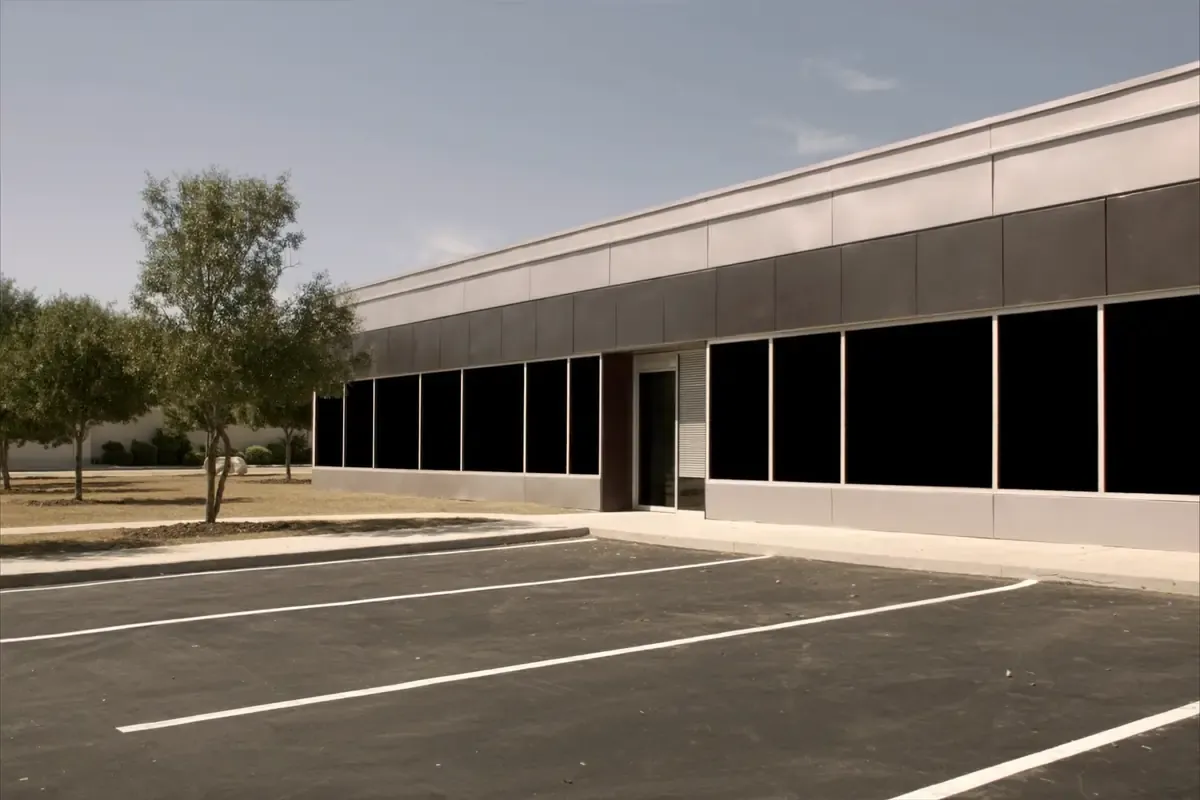
What is a pre-engineered commercial metal building?
Steel designed for your building before any of it is cut. Rigid frames carry the roof and the walls, so the floor has no columns across the width they span. Bay spacing, eave height, door openings, insulation and trim are fixed in the order, because the steel is punched and welded for them at the plant. That is what pre-engineered buys and costs: a wide clear floor with the office, restrooms and break room framed inside it, and a frame that is expensive to change once detailed.
Size decides whether an engineer is optional in state law. Occupations Code 1001.056 lets a building skip the state engineering chapter when nobody holds out to offer engineering services to the public and the building is one story, 5,000 square feet of floor or less, with no clear span wider than 24 feet across its narrow side; with longer spans, only the roof-carrying members need engineering. Almost every working commercial building sits outside that exemption.
Checked at Texas Legislature Online, Occupations Code Chapter 1001, engineers and engineering, 2026-09-13.
Who commercial metal buildings fit, and who they do not
They fit a business that needs an open floor, a tall door and space that customers, patients or staff walk into: a contractor yard with a counter, a clinic, a retail suite, a service building with bays. A clear span with no interior columns also re-partitions later without touching the structure.
They do not fit three readers. If the building is racking, forklifts and a dock rather than customers, the eave height, the doors and the fire question all change, and that is industrial buildings and warehouses. If it is your own shop on your own home lot, the state accessibility rules do not reach it, because TDLR says the architectural barriers law and the Texas Accessibility Standards are for public and commercial buildings, not private residences. That lane is metal shop buildings. And if it is storage under a roof with nothing conditioned, post-frame may do the job with less steel.
Running a business out of a house does not settle it: the 2012 Texas Accessibility Standards cover the portions of a private residence used in operating a business.
Checked at Texas Department of Licensing and Regulation, elimination of architectural barriers at a glance, 2026-09-13.
Checked at Texas Department of Licensing and Regulation, 2012 Texas Accessibility Standards, scoping requirements, 2026-09-13.
Which office reviews a commercial building, the city or the county?
Whichever one holds the address, and the two paths look nothing alike. Inside the City of San Antonio a commercial project runs through Development Services: zoning, plan intake, plan review, permit, inspections, utility release, certificate of occupancy. Both the application and the permit expire within 180 days without proof of work or progress.
In unincorporated Bexar County the Fire Marshal Office at 210-335-0300 determines when building permits are required for structures that are not for single-family dwelling use, and that permit covers site clearing as well as constructing or renovating a building. A Building Permit Authorization from Public Works gets signed off first, and the county then has 30 days to rule. On a commercial pad out there, the permit comes before the first tree does.
The county path is short because of the statute: Local Government Code Chapter 233 leaves a county without authority to adopt a general commercial building code, and only a county of more than 250,000 people, or one bordering a county that size, may adopt a fire code and require its permit. So the answer changes at every county line. Four of the seven publish a path to a county permit for a non-residential building and three publish none, and Wilson County is the one owners miss: no county building permit as such, but a development permit that sends a commercial structure to a fire safety meeting first.
Below is what each county's own site publishes. Your county sheet, with the office and the phone number, is on the county index, and the full path is on metal building permits in San Antonio and Bexar County.
| County | What the county publishes outside the cities |
|---|---|
| Bexar County | The Fire Marshal Office, 210-335-0300, determines when building permits are required for structures not for single-family dwelling use, and that permit covers site clearing. |
| Atascosa County | A building permit from the Fire Marshal and Emergency Management Office, 830-769-2029, before a new commercial or public building, a remodel for a new type of business, or a multifamily dwelling with four units or more. |
| Guadalupe County | A permit from the Fire Marshal Office, 830-303-8856, before constructing or substantially improving a commercial establishment, public building or multi-family dwelling, under the fire code order effective February 1, 2026. |
| Wilson County | No county building permit as such. A development permit at $100 per application, with a fire safety meeting scheduled for a commercial structure before approval, through Permitting and Development at 830-393-8357. |
| Medina County | No building permit on the county permit list. The five it publishes are 911 addressing, water well, floodplain, septic, and driveway and utility, at 830-741-6000. |
| Karnes County | No building permit on any page checked. The county lists special projects and septic permits and road and bridge permits, at 830-780-3511. |
| Frio County | No building permit on any page checked. Road and Bridge, 830-505-7402, runs septic, floodplain, utility right of way and pipeline permits. |
Checked at City of San Antonio Development Services, business and commercial projects, 2026-09-13.
Checked at Bexar County, building permits and fire marshal code enforcement pages, 2026-09-13.
Whole chapter checked; it gives counties no such power. Checked at Texas Legislature Online, Local Government Code Chapter 233, county regulation of housing and other structures, 2026-09-13.
Checked at Atascosa County Fire Marshal and Emergency Management Office, Permit and Inspection Process Overview, 2026-09-13.
Checked at Guadalupe County Commissioners Court, Order Adopting a Fire Code and Regulations for Its Enforcement, January 27, 2026, 2026-09-13.
Checked at Wilson County, Development Permit application packet, 2026-09-13.
Checked, and the item is not there. Checked at Wilson County, Permitting and Development, 2026-09-13.
Checked, and the item is not there. Checked at Medina County, What Type of Permits Are Required In Medina County?, 2026-09-13.
Checked, and the item is not there. Checked at Karnes County, Special Projects and Permits, 2026-09-13.
Checked, and the item is not there. Checked at Frio County, County Engineer and Road and Bridge Department, 2026-09-13.
What does the $50,000 accessibility line do to a commercial building?
It puts a state step in front of the local permit, and most commercial buildings clear the line on the slab alone. Any project with $50,000 or more in total estimated construction cost must be registered with TDLR, and the full construction set goes to a registered accessibility specialist under Administrative Rule 68.50. Government Code 469.102 then bars the owner from applying for a local building permit or starting construction before those plans are submitted, and bars a permitting official from accepting the application unless the official verifies the building is registered. San Antonio confirms it: the city does not review accessibility sheets itself and sends any project valued over $50,000 to TDLR.
Two details set the number and the bill. TDLR leaves the land, the design fees, furnishings and equipment outside the building mechanical systems out of the estimated construction cost, so the figure that decides it is smaller than the project budget. TDLR charges a $175 project filing fee and a $300 late filing fee, and the specialist who does the plan review and inspection sets a separate fee TDLR publishes no amount for. Get that quote in writing when you price the building.
Checked at Texas Department of Licensing and Regulation, Architectural Barriers frequently asked questions, 2026-09-13.
Checked at Texas Legislature Online, Government Code Chapter 469, elimination of architectural barriers, 2026-09-13.
Checked at City of San Antonio Development Services, commercial project application guide, 2026-09-13.
Checked at Texas Department of Licensing and Regulation, Architectural Barriers special project registration application, 2026-09-13.
Checked at Texas Department of Licensing and Regulation, Architectural Barriers fee schedule, 2026-09-13.
Who has to seal the drawings?
A Texas professional engineer, on the structure, for anything built inside the city. The San Antonio commercial project application guide states that all structural sheets, the foundation and structural framing, must be stamped and designed by a Texas professional engineer, and that trade and civil documents might also need it depending on the scope.
The architect question turns on who owns the building. Occupations Code 1051.703 reserves plans to an architect for publicly owned education, assembly and office buildings costing over $100,000, for alterations over $50,000 to them that move a wall or alter an exit, and for buildings occupied around the clock by people in custodial care. Under section 1051.606, someone who does not present themselves as an architect may draw the plans for a commercial building in private hands no taller than two stories and no larger than 20,000 square feet. Treat that as a floor: the city lists documents sealed by an architect as a submittal item without a size threshold of its own, so ask the reviewing office.
Checked at City of San Antonio Development Services, commercial project application guide, 2026-09-13.
Checked at Texas Legislature Online, Occupations Code Chapter 1051, architects, 2026-09-13.
What the slab under a commercial building has to carry
The building, bolt for bolt. Rigid frames land on anchor bolts cast into the concrete at the spacing on the manufacturer's anchor bolt plan, and the column reactions on that plan size the foundation. A slab poured before that plan exists may have to be drilled, cut or replaced. The floor then carries whatever the business sets on it, more under a shop with a two-post lift than under a clinic.
The ground here is not one ground. The USDA Soil Survey of Bexar County, Texas (1966), checked 2026-09-13, describes the north of the county as shallow or very shallow stony soil over Glen Rose and Edwards limestone, the Tarrant soils running a few inches to about 10 inches of clayey surface over hard fractured rock, and puts deep shrink-swell clay on the eastern and western uplands, cracking wide when it dries. Rock near the surface changes what excavation costs; deep clay changes the slab section and the moisture detailing. Two identical buildings 20 miles apart do not get the same foundation, which is why a soil report earns its fee.
Does the pad need an Edwards Aquifer plan or stormwater coverage?
On the north side of Bexar and Medina counties, quite possibly, and it is the longest clock on the job. TCEQ requires an approved Edwards Aquifer protection plan before construction begins on the recharge, transition or contributing zones, and names Bexar and Medina among the counties in this region. Only parts of the aquifer are regulated, and TCEQ's own map viewer settles a given site. On the recharge zone, nothing regulated happens without an approved water pollution abatement plan, and TCEQ counts putting up buildings, clearing and digging as regulated; on the contributing zone a plan is needed only where the activity disturbs at least five acres, a line parking and a truck approach can cross.
Plan around the schedule: administrative review is set two weeks from submission and can take up to 30 days, technical review then has 90 calendar days, and construction may not begin until approval issues.
Stormwater is a separate filing, set by disturbed acreage rather than by the building: an acre or more of disturbed soil brings in coverage under the TCEQ construction general permit, with a pollution prevention plan in place before work starts. That coverage does not release a site over the aquifer, because the permit bars construction at an Edwards-regulated site until the protection plan is approved. Bexar County adds a storm water quality permit at $500 on the same one-acre trigger (Bexar County Public Works Permits Verification Guidelines, checked 2026-09-13).
Checked at Texas Commission on Environmental Quality, Edwards Aquifer Protection Program, 2026-09-13.
Checked at Texas Commission on Environmental Quality, Edwards Aquifer Protection Program, what plans you might need, 2026-09-13.
Checked at Texas Commission on Environmental Quality, Edwards Aquifer application and review process, 2026-09-13.
Checked at Texas Commission on Environmental Quality, construction stormwater general permit TXR150000, 2026-09-13.
Checked at Texas Commission on Environmental Quality, general permit TXR150000, part II, 2026-09-13.
Checked at Bexar County Public Works Department, Public Works Permits Verification Guidelines, 2026-09-13.
Parking, the driveway and how traffic gets onto the lot
Parking is a zoning question, and zoning is the first stop on the city path, not something the building permit sorts out later. No record on this site carries a parking ratio for a commercial use, so this page prints none: the spaces your use has to provide come from the jurisdiction that has your address. Ask before the footprint is fixed, since parking and drive aisles commit more of the lot than the building.
The driveway is its own permit. For a new or changed driveway onto a state highway the applicant files TxDOT Form 1058 at the local district office; no one touches the right of way before that permit is executed. Six of these seven counties sit in the TxDOT San Antonio District at 210-615-1110; Karnes County does not, so a driveway there runs through a different district. On a county road the county usually issues it, and the office and the fee differ by county line. Bexar County Public Works controls work in county-maintained rights of way and charges $35 per driveway (Bexar County Public Works, Right-of-Way Permits, checked 2026-09-13). Frio County is the exception: no driveway permit and no culvert permit appears on the county site, so that call goes to Road and Bridge at 830-505-7402 first. Every county office and fee sits on the county sheet for that address.
Checked at City of San Antonio Development Services, business and commercial projects, 2026-09-13.
Checked at Texas Department of Transportation, access management manual, driveway permits, 2026-09-13.
Checked at Texas Department of Transportation, San Antonio District, 2026-09-13.
Checked at Bexar County Public Works Department, Right-of-Way Permits, 2026-09-13.
Checked, and the item is not there. Checked at Frio County, County Engineer and Road and Bridge Department, 2026-09-13.
What do septic, water and power take on a lot with no services?
Septic first, because the design decides where the building can sit. A permit and approved planning materials are required to install an on-site sewage facility, and the permitting authority approves or denies within 30 days. The septic rules count any building that is not a single-family home or a duplex as a commercial facility, whatever its size, and a professional engineer or sanitarian must prepare and seal the planning materials for non-standard treatment or disposal and for all new construction in the Edwards Aquifer recharge zone.
Power is the long lead. CPS Energy runs new commercial service as a 14 step process and publishes waits of roughly 15 business days to set the transformer, up to three weeks for easement processing, and 10 business days to set the meter after the inspection release. Water depends on whether a main reaches the lot: San Antonio Water System treats servicing a vacant lot as a new service and charges a one-time impact fee, and outside its area the answer is a well.
Checked at Texas Commission on Environmental Quality, getting a permit for an on-site sewage facility, 2026-09-13.
Checked at Texas Commission on Environmental Quality publication RG-472, on-site sewage facility rules compilation, 2026-09-13.
Checked at CPS Energy, new commercial construction, 2026-09-13.
Checked at San Antonio Water System, developer resources, new service, 2026-09-13.
Checked at San Antonio Water System, water and sewer impact fees by meter size, July 2024, 2026-09-13.
Who puts the building up?
An erection crew, working from the anchor bolt plan and the erection drawings that ship with the frame. They set the first bay plumb and braced, run the rest of the frames off it, then the purlins, girts, sheeting, trim and doors. Crane time is short and expensive, so the slab has to be cured, square, level and at the right elevation before the steel arrives.
Checking that crew works differently than owners expect. Home builders and general contractors carry no Texas state license. The Texas Residential Construction Commission is gone, its act having expired September 1, 2009, and the TDLR list of regulated industries names no builder, general contractor, remodeler or metal building program. With no builder registry to look anyone up in, the checking happens on paper: references on buildings the same size, a certificate of insurance, and a scope in writing.
Checked at Sunset Advisory Commission, Texas Residential Construction Commission; TDLR regulated industries list, 2026-09-13.
What to ask commercial metal building contractors for
Ask for the scope in writing before comparing two numbers, because two numbers are rarely the same scope. No metal building company serving the San Antonio area publishes a price: the four company sites checked on 2026-09-13 all route to a quote request, so every number is quoted to your lot and your drawings.
Whether the price is the steel package delivered, or turnkey with site work, slab, erection and finish-out.
Who designs and seals the foundation, and whether the anchor bolt plan is in hand before concrete.
Who files the TDLR registration and who pays the accessibility specialist, whose fee TDLR does not publish.
Who pulls the local permit, and who files the floodplain, stormwater, driveway and septic permits.
What is excluded: utility connections, impact fees, agency fees, and anything resting on a survey nobody has run.
A schedule that names the review windows it depends on, not one finish date.
Company price pages checked; none shows a figure. Checked at Four San Antonio-area metal building company websites, 2026-09-13.
Checked at Texas Department of Licensing and Regulation, Architectural Barriers special project registration application, 2026-09-13.
How long does a commercial building take to get through review?
Inside the city it is set by occupancy and size. A business or mercantile project of 7,999 square feet and under is a minor plan: three business days for completeness, eight for the initial technical review. At 8,000 square feet or over, and for assembly, factory, institutional and storage occupancies at any size, it is a complex plan at 18 calendar days. In unincorporated Bexar County the clock is the county one: the Fire Marshal gets 30 days to rule, and the permit then runs 180 days. Plan review is rarely the long pole either way. The aquifer plan and the power connection are, so start those first, in the order on the start-to-finish San Antonio guide.
Checked at City of San Antonio Development Services, commercial project application guide, 2026-09-13.
Checked at Bexar County, building permits and fire marshal code enforcement pages, 2026-09-13.
Checked at Texas Commission on Environmental Quality, Edwards Aquifer application and review process, 2026-09-13.
Checked at CPS Energy, new commercial construction, 2026-09-13.
What owners ask
Do commercial metal buildings need a permit in San Antonio, TX?
Inside the City of San Antonio, yes: a commercial project goes through plan review at Development Services, on a path of zoning, plan intake, plan review, permit, inspections, utility release and certificate of occupancy. In unincorporated Bexar County the Fire Marshal Office at 210-335-0300 determines when building permits are required for structures that are not for single-family dwelling use, and that permit covers site clearing as well as construction. A state step applies everywhere at $50,000 or more in estimated construction cost, when the project must be registered with TDLR (Texas Department of Licensing and Regulation). Checked at City of San Antonio Development Services, Bexar County and the TDLR pages, 2026-09-13.
When does a commercial building have to be registered with TDLR?
Once total estimated construction cost reaches $50,000. Any project at or over that figure must be registered with TDLR (Texas Department of Licensing and Regulation), with a full set of construction documents going to a registered accessibility specialist under Administrative Rule 68.50. Government Code 469.102 bars the owner from applying for a local building permit or starting construction before those plans are submitted, and bars a permitting official from accepting the application unless the official verifies the building is registered. The cost figure leaves out the land, design fees, furnishings and equipment outside the building mechanical systems. Checked at the TDLR Architectural Barriers pages and Government Code Chapter 469, 2026-09-13.
Who issues the permit for a commercial building outside San Antonio city limits?
It depends on the county, because Local Government Code Chapter 233 leaves a Texas county without authority to adopt a general commercial building code, and only a county of more than 250,000 people, or one bordering a county that size, may adopt a fire code. In unincorporated Bexar County the Fire Marshal Office issues the permit for structures that are not for single-family dwelling use, with 30 days to issue or deny. Atascosa County requires a Fire Marshal permit before a new commercial or public building, and Guadalupe County requires one under a fire code order effective February 1, 2026. Wilson County publishes no county building permit as such, but its development permit at $100 per application has a commercial structure schedule a fire safety meeting before approval. The Medina, Karnes and Frio county sites list none. Checked at each county site, 2026-09-13.
What do commercial metal buildings cost in the San Antonio area?
No metal building company serving the San Antonio area publishes a price. The four company sites checked all route to a quote request instead of a figure, so a figure only comes as a quote written for the actual site. The published figures are the agency ones. TDLR charges a $175 project filing fee and a $300 late filing fee, and publishes no amount for the registered accessibility specialist, who sets a separate fee. The City of San Antonio prices a commercial building permit on valuation, at $560.00 plus $2.00 per $1,000 above $75,000 in its top band, and the city sets that valuation. Checked at four San Antonio-area metal building company websites, the TDLR fee schedule and the City of San Antonio FY 2026 fee schedule, 2026-09-13.